Monday, 23 June 2025

Flattened Wonder: When Genesis Becomes Arithmetic

 “In the beginning…”

The opening words of Genesis don’t just start a story—they strike a chord that resonates through every particle of reality. And yet, somehow, we’ve reduced them to… a calculator?

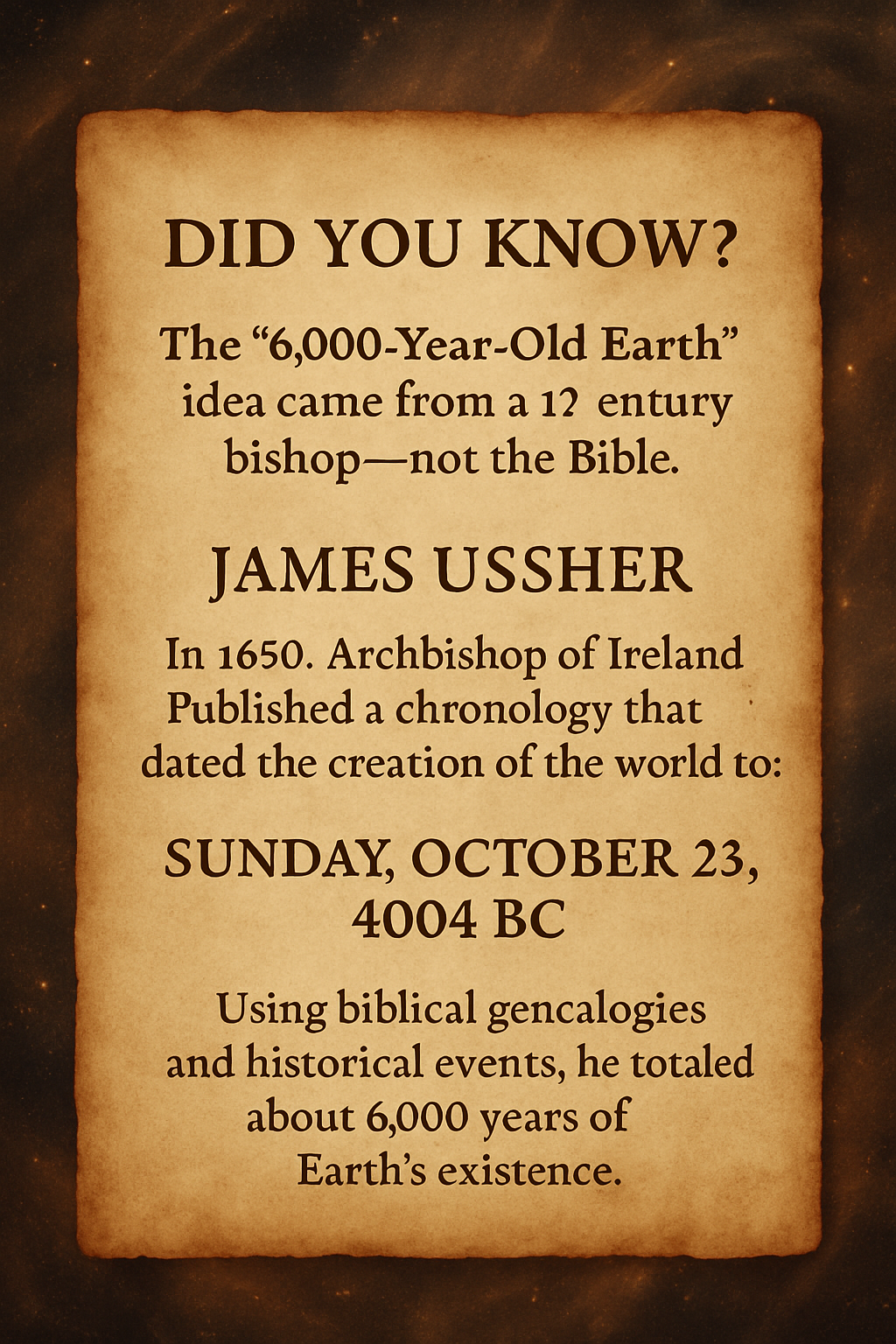
Last Sunday, our preacher opened to Genesis 6—a rich and enigmatic chapter—but before diving into its depth, he announced that the Earth is only 6,000 years old, maybe 10,000 max. Why? Because, he explained, if you trace the years from Adam to Abraham (2,000), Abraham to Christ (2,000), and Christ to now (another 2,000), voilà—6,000 years. Simple math.

But something in me recoiled—not from arrogance, but from grief.
Because that moment was not just the flattening of time, but the flattening of wonder.


🌌 The Universe is Not a Spreadsheet

Modern science tells us that what we once thought of as "formless"—empty space—is in fact alive with mystery. Quantum fields, dark matter, unseen energies ripple and hum beneath the surface of what our eyes can’t perceive. And Augustine, writing over 1,600 years ago, had already asked:

What does it mean for something to be “formless”? Can something exist but not yet be shaped?

He didn’t try to fit Genesis into a human timeline. He stood back in reverence and said:

“Let us not be quick to assume one meaning, where God may have intended many.”

Augustine saw God as timeless, creating not in days as we count them, but in movements of order, purpose, and beauty. And more importantly, he warned that misusing Scripture to say foolish things could harm the very faith we claim to defend.

“When unbelievers catch us making a mistake in a field they know well and hear us maintaining our foolish opinions about our books, how are they to believe those books contain divine truths?”
— Confessions, Book V


🕯️ A Gospel for the Hungry Mind

When sermons ignore the wonder of creation and treat Genesis like a dusty genealogy ledger, it’s no wonder some people—especially the curious, thinking ones—walk away from the Church.

Not because they hate God.
But because they’ve been fed stale bread, when they were starving for mystery and meaning.

We need to stop shrinking Scripture down to fit our charts. The Bible was never meant to be a science textbook or a punchline against astronomers. It is a living word, inviting us to behold a God who creates not from boredom or need—but from the overflowing joy and harmony of Triune love.


📖 When the Bible Meets the Cosmos

When I read Genesis now, I don’t see a stopwatch—I see a song.
A cosmic liturgy where light speaks, chaos is calmed, and meaning emerges from the void.
And maybe what was once called “formless and empty” is not so empty at all.

Because God was there.
And that’s never nothing.

Sunday, 22 June 2025

✨ Journal Entry: Drifting from Light, Unbecoming Human

 (A guided meditation from Book XII of Augustine's Confessions)

“The further away from You things are, the more unlike You, they become.”
Reading Augustine’s final reflections on creation, I paused here. These words struck something deep in me. Not just about the world, but about me—my soul, my story.

As I sat with them, I found myself thinking:

The more I move away from God, the less human I become.
Not in a mythical sense, but in the very fabric of my being.

When I am far from Him, I’m not just lost—I’m unraveling. I become more like formless matter, pulled apart by scattered loves and half-baked desires. My mind races, my heart clings to what fades, and my soul bends in on itself. That’s what sin is—it’s not just wrongdoing. It’s de-creation. It's becoming less.

And yet—He holds me together.

“I seek not to understand so that I may believe, but I believe so that I may understand.”

Augustine’s confession feels like my own prayer. I don’t understand all things—I hardly even understand myself most days. But I know this:

I would be nothing without Him.
Without His grace, His patience, and His unrelenting mercy, I would fade into the shadows of what I was meant to be.

Even in my restlessness, even in my failures—He forms me. Again and again.

The world didn’t begin with shape or order—it was formless and void.
And so was I, until He began to speak light into me.

Saturday, 21 June 2025

Time, Eternity, and the Ache for the Infinite:


A Journal Entry After Reading Book XI of Confessions

"What then is time? If no one asks me, I know what it is. If I wish to explain it to him who asks, I do not know." — St. Augustine

Augustine doesn't simply ask what time is—he opens the door to wonder. In Book XI, he turns from his confessional journey and asks: What does it mean to say, “In the beginning God created the heavens and the earth”? What was there before that beginning? Was God doing something? Was He silent?

He rebukes the sharp-tongued answer—"God was preparing hell for those who ask such questions"—not because it’s irreverent, but because it’s impatient. For Augustine, every question that arises from awe should be met with reverence. So he sits with the mystery.

And he says: God did not create in time; He created with time. Time is part of creation itself. God is outside of it—not bound to before or after, past or future. For God, all things are present. That which is yet to come and that which has passed—He sees them as one eternal now.

But we humans—oh, how we struggle. We measure time with clocks, the sun, the ticking of atoms, or the tremble of our own hearts. But time isn't only measured in motion. Augustine says we measure time in the soul: past as memory, present as attention, future as expectation.

I resonate with his wondering. Time slips through our fingers even as we try to hold it down. A good day can vanish in a blink. A moment of suffering can feel eternal. Does time move, or do we move through it?

Sometimes I wish I had someone beside me to pause over every paragraph, to sit in the wonder together. But even in solitude, I wrestle. And in that wrestling, I think:

Time may be a created shadow of eternity—a holy echo. Perhaps it exists not to trap us, but to teach us: that we were made for something more than seconds. We were made for the forever-present.

"You are my eternity, but I am divided in time." — Augustine

So, I wait in this time, with my heart stretched across memory and hope. And I trust that while time may pass, grace does not.


This reflection is not a system, but a longing. Not an answer, but a window. Not a timeline, but a turning toward the Timeless One.

Desire, Memory, and the Mirror: Wrestling with Augustine, Lewis, and the Imago Dei


There’s a haunting question Augustine asks in Confessions, Book X:

"How can I seek God unless I already know something of Him?"

It lingers not as an academic puzzle, but as a spiritual ache. How can we long for something we've never seen? How does the soul ache for a presence it has never embraced?

Augustine proposes that the answer lies deep within the memory—a mysterious, recondite storehouse where truth might be hiding, waiting to be unearthed. We are drawn toward God, he says, because something of Him is already imprinted in us. Not in a pantheistic sense, but as an echo of the One in whose image we were made.

C.S. Lewis would echo this centuries later:

"If I find in myself a desire which no experience in this world can satisfy, the most probable explanation is that I was made for another world."

The longing is the evidence.

But I wrestle with this: Is God truly buried somewhere within me, waiting to be uncovered like a coin in a dusty drawer? Or is it that the desire for Him, the yearning, is the sign that He stands outside of me, calling me home?

This is where my understanding of the Imago Dei comes in.

The Mirror, Not the Spark

I've long been drawn to the interpretation of Imago Dei taught by N.T. Wright and John Walton: not that we carry a divine spark, but that we are angled mirrors. Our vocation is to reflect God’s justice, love, and beauty into the world—and to reflect the praises of creation back to Him.

In this sense, the image of God is functional and relational, not ontological. It’s not that God is in us like a divine shard, but that we are designed to be creatures-in-communion, capable of mirroring heaven to earth and earth back to heaven.

Augustine, with his Neo-Platonic leanings, might push closer to the soul as containing divine traces—reason, memory, and will being the inner trinity that images the Divine Trinity. But even he stops short of saying the divine is inherent. Instead, he emphasizes that our souls are restless until they rest in God. That rest, for him, comes from outside, even if its hunger stirs within.

So perhaps both are true:

  • Desire is born from the memory of what we were made for.

  • And we remember—not clearly, but like a dream we can’t quite name—that we were made to mirror Love Himself.

Restless, but Anchored

Reading Augustine in a heavy season of my own, I feel his ache. I, too, am searching—sometimes through study, sometimes through silence. Some memories rise easily. Others hide in those "recondite receptacles"—the dark, unreachable rooms of the soul. But even there, God can dwell.

And maybe that’s the good news: even when we forget, God remembers. Even when the mirror is cracked, it can still catch the light.

"You were more inward than my innermost self." — St. Augustine


This journal entry is a humble wrestling—not a conclusion. A glimpse, not a system. A whisper of that other world our hearts keep aching for.

Tuesday, 17 June 2025

Living in a Digital Panopticon — And Still Asking, “Why So Much Chaos?”


Lately, a strange phrase has been echoing in my head—digital panopticon.

I heard it in a podcast, possibly while the speaker was reflecting on the ideas of Byung-Chul Han, the Korean-German philosopher. The phrase may not be his invention, but the concept fits seamlessly into his worldview: a society of hyper-transparency, where surveillance is no longer imposed from above but internalized by individuals. We post, we perform, we curate—and call it freedom. But in truth, we are burning out under the weight of self-exposure.

Han’s work is striking—not only because of its piercing insight, but also because it comes from an Asian intellectual voice in a conversation so often dominated by the West. As someone who has mostly read Western thinkers, I find something deeply affirming in that—wisdom has no borders.

This thought connected itself to another one that’s been lingering in my mind: Neil Postman’s warning that we are amusing ourselves to death. Entertainment isn’t the enemy. But in a world so saturated with fun, with the addictive drip-feed of reels and endless scrolling, we’ve forgotten how to be still. To sit in silence. To ask hard questions. To feel anything deeply.

And what a strange world we live in.

In one part of the globe, there’s war—bombs falling, lives ripped apart, families fleeing rubble. Meanwhile, in another part, there’s celebration—a FIFA Club World Cup, stadium lights, chants and cheers. Locally, people are dying by suicide, communities are divided, natural disasters sweep through, and news of violence barely shakes us anymore.

And I? I’m somewhere in between. Watching. Scrolling. Worrying. Wondering. I grieve for the world, and yet I’m not sure if I really feel it—because I have my own struggles to deal with. Maybe numbness is part of the burnout too.

So, here’s the age-old ache that keeps surfacing:
Why is there so much unhappiness, chaos, and disunity in the world?

It’s a question that has made many walk away from belief. If there’s a God—and if He is good and wise—how could He allow this?

The simplest answer offered in Christian thought is this: free will. We are not puppets. God gave us the freedom to love, to create, to choose—and in doing so, also the freedom to destroy. We often talk about sin as a private thing, but in Scripture, sin is also corporate. One person’s failure can devastate a community. The fall of one spills outward. Pain echoes across relationships, generations, and even creation itself.

The world is fractured, not because God isn’t good, but because freedom is real—and sin is heavy.

But here’s the quiet hope: in noticing the brokenness, maybe we’re also resisting it. In feeling the sorrow, we are still human. In stepping away from the noise, even for a moment, we make space for something deeper.

Maybe, just maybe, these questions—uncomfortable as they are—are where healing begins.

Monday, 16 June 2025

Journal Reflection – Book VII: When the Light Begins to Tremble Through


Journal Reflection – Book VII: When the Light Begins to Tremble Through

I have finished reading Book VII. Augustine is standing at a threshold—his mind awakened, but his heart still wrestling. He is shedding the false gods of his past—Manicheism, astrology, the idea that evil is a thing created by God. And yet, he is not yet fully ready to bow. Not yet.

I understand this space. I, too, feel like I’m waiting for something to break open—longing for clarity while standing in the fog. My heart is heavy these days. A prayer I hoped would be answered… wasn’t. Not in the way I wanted. It’s not romantic grief, but the kind that presses on the chest, quietly, with disappointment and confusion. A sacred ache.

Augustine spoke of God and evil, quoting Scripture, weighing ideas with the minds of Plato and Plotinus. But it wasn’t enough to know truth—he wanted to meet Truth.
And I think, maybe, I’m like that too.

"You have made us for Yourself, O Lord, and our heart is restless until it rests in You."

That line rings truer than ever—not as a quote, but as my soul’s quiet cry.
I, too, have chased understanding. I, too, have run from my own pain.
And even now, I find myself saying:

“Turn Your gaze away from me, Lord… for I feel unworthy.”
But also:
“Don’t go too far… I won’t survive without You.”

Augustine begins to grasp something in this chapter—not yet full surrender, but a trembling light breaking through the cracks. He sees Christ not just as a teacher of truth, but as the Truth made flesh, the One who alone can lift the burden between divinity and humanity.

I don’t have answers right now.
But I have tears. And I have hope.
And like Augustine, maybe that is enough for now.

Because apart from You, Lord, I will never flourish.
And maybe… just maybe… someone is still praying for me.

Friday, 6 June 2025

The Little Thief and the Plums

 🍃 

I’ve been reading Augustine’s Confessions, and somewhere between his grand theology and his stolen pears, I found myself unexpectedly disarmed.

Augustine—this giant of Christian thought—paused to reflect not on some dramatic crime, but on a moment from his youth when he and his friends stole pears from a neighbor’s tree. He didn’t even eat them. He threw them away. And yet, he confessed it as sin—not because of the fruit, but because of what the act revealed about his heart. He did it because others did it. He did it for the thrill of transgression itself.

That moment took me back.

I must have been in Standard VI when a few of us, just kids with more energy than wisdom, found ourselves wandering near a garden. There was a plum tree inside. It started as a joke—someone said, “Let’s take some,” and the idea gained traction not because we were hungry, but because we were together. The peer pressure was gentle, disguised as play. One friend warned us that the owner was known to use poison arrows on thieves. That should have ended the idea, but somehow it made it all the more daring. We hesitated. Then we crossed the line.

After we took the fruit, we ate it, half-laughing, thinking we had gotten away with it. But one of us started running—we were fleeing from someone or something harder to name. I remember running faster than anyone, not because I feared punishment, but because the owner knew me. If he had seen me, it wouldn’t have been scolding I feared—it was the shame of being recognized. I wasn’t just escaping his eyes; I was running from the version of myself I didn’t want to be seen! 

Funny how the moments we later laugh about often carry more weight than we admit. Back then, we called it mischief. But now, through Augustine’s eyes, I see something else: a moment where my desire to belong was stronger than my desire to be good. A time when I traded conscience for company, knowing deep down that I wouldn’t have done it alone.

That’s the power of Confessions. It doesn't just make us think about Augustine’s life—it quietly calls us to examine our own. And so, as I continued journaling, I wrote this small psalm as a response—not to the plum, but to the pattern it revealed.


🕊️ Journal Psalm: On the Day I Stole Fruit with Friends

O Lord of the orchard and the heart,
You saw me when I was still small,
barely taller than the bush I trespassed.

I ran with the pack—
not for hunger,
not for hatred of the owner,
but for the thrill of doing what we whispered we should not.

It was not the plum I loved,
but the moment we plucked it—together,
like rebels against a law
we only half-believed.

I laughed,
but even in laughter, I knew—
This is not mine.
And yet, I ate.
Not from need, but from belonging.

You did not strike me with a poison arrow,
though I feared it.
You let me run, legs burning,
heart louder than footsteps—
and still, You watched with mercy.

What fruit have I stolen since then, Lord,
not from gardens,
but from truth,
from love,
from time that was Yours?

Let me no longer be the boy
who runs after what is wrong
just to run with others.

Let me be the one who runs to You,
even if it means standing alone,
even if the fruit stays hanging
where it belongs.

Amen.

Monday, 26 May 2025

Herd Instinct and the Grand Inquisitor: The Death of Thought in a Comfortable Age


"If I speak out, I will be cast out."

This line captures the chilling truth that Dostoyevsky, Stanley Milgram, and our modern digital reality all seem to scream: to go against the crowd is to walk alone. And yet, isn't that the only path to truth?

The Herd Instinct: Stay with the Gang or Die

The human tendency to conform, to follow the crowd, is not new. It's evolutionarily wired. In ancient times, being exiled from the tribe could mean literal death. And so, even today, a silent part of our psychology says: Don't rock the boat. Stay quiet. Follow.

Stanley Milgram's infamous experiment—where ordinary people administered what they believed were painful electric shocks to strangers just because an authority figure told them to—exposed this terrifying obedience in action. Even the educated, the "rational" people, followed orders blindly.

And that's the most unsettling part: even highly educated individuals, people trained in critical thinking, people with degrees and accolades, often succumb to the same herd instinct. Education alone does not immunize one against conformity. In fact, the more institutionalized the knowledge, the stronger the pull to obey the dominant norms and not challenge the framework that granted one their social credibility.

What we're seeing today is a refined version of the same dynamic. It’s not a man in a lab coat anymore—it’s the blue checkmark, the trending hashtag, the office culture, the academic consensus. The result? Gullibility dressed in intellectual robes.

Dostoyevsky's Thunder: The Grand Inquisitor

In The Brothers Karamazov, Dostoyevsky introduces us to one of literature's most haunting dialogues. In "The Grand Inquisitor," Christ returns to earth during the Spanish Inquisition. He performs miracles, is recognized—and is promptly arrested by the Church.

The Grand Inquisitor, an old cardinal, visits Jesus in His cell. Not to plead or worship, but to rebuke.

He accuses Christ of giving humanity the unbearable gift of freedom—when all people truly want is bread, spectacle, and certainty. He breaks down Christ's rejection of Satan's three temptations as missed opportunities:

  1. Turn stones to bread – Give them miracles and physical security. They’ll worship you for it.
    ✝️ Christ said no—He valued freedom of faith more.

  2. Leap from the Temple – Prove you’re divine through spectacle. Give people something to follow blindly.
    ✝️ Christ refused—He would not manipulate belief.

  3. Bow to Satan and rule the world – Take power, unify the earth under your authority.
    ✝️ Christ declined—He wanted humans to choose love freely, even at the cost of suffering.

"We shall deceive them again—for their good," says the Inquisitor.

It is a theology of despair dressed as compassion. He believes people are too weak for freedom, and the Church must control the herd in Christ’s name—even if Christ Himself must be silenced.

Jesus’s only answer is a kiss. Then silence. And the Inquisitor lets Him go, whispering: "Come no more."

Fast-Forward: The Inquisitor Has Wi-Fi Now

In the 21st century, the Grand Inquisitor hasn’t died. He’s just gone digital.

1. Bread → Consumerism

The people will not think; if you keep them fed, entertained, and make them comfortable. The new bread is instant delivery, binge content, and dopamine hits. Why suffer through complex truths when you can scroll through easy lies?

2. Miracle → Spectacle Culture

The miraculous is replaced by virality. Truth is not what's real, but what trends. Influence is mistaken for integrity. A reel with 1 million views has more authority than a book written over ten years.

3. Power → Ideological Conformity

We are ruled not by kings but by invisible algorithms, party lines, and culture war echo chambers. Step out of line, and you're branded: traitor, bigot, heretic. Cancelled, cast out.

The herd doesn’t burn heretics anymore. It erases them through silence or mass ridicule.

The Cost of Freedom

In today’s world, to think for oneself is to suffer. To reject the herd's narrative is to face exile. Yet in that very exile, we rediscover the dignity Dostoyevsky fought to illuminate:

  • Alyosha, who walks the path of compassion without ever surrendering to the crowd.

  • Christ, who would rather die in silence than rule by force.

So Where Are We Now?

We are in the same prison cell. Christ still stands silently. The Inquisitor still talks. And each of us must decide:

Will I follow the herd—or carry the unbearable freedom to think, speak, and live authentically?

To speak out is to risk being cast out.

But to stay silent… is to disappear into the herd.

Written in defiance. In solitude. In freedom.

Monday, 19 May 2025

Faith Isn’t Fragile—It Just Needs Roots


I was watching a video the other day where someone was talking about their journey of "deconstruction." He spoke as if evolution being true was this earth-shattering revelation that broke his Christian worldview. I nearly spilled my coffee! Like, many of us have known and accepted evolution, and it didn't shake our faith. Why? Because our foundation was never just about a literal reading of Genesis — it was (and is) about a Person: Jesus Christ.

The speaker went on, denying the resurrection and claiming there's no good evidence for it. And I paused. Not because I was shaken, but because I realized something: I don't believe because I have undeniable proof. I believe because I trust the witnesses. I believe because that's how history works. That's how life works. We trust our plans for tomorrow even though we aren't guaranteed to wake up. We live by faith in a hundred unseen things daily. Why should faith in God be any different?

And then I remembered Jesus' parables. But—before that! 


What is Deconstruction?

Deconstruction is a word we hear a lot today — and it's not always rebellion. Sometimes it's grief, disillusionment, or even honesty. It happens when people begin to question what they were taught, especially if that teaching felt rigid, shallow, or abusive. It's often triggered by suffering, exposure to new information, or the painful hypocrisy of Christians themselves.

Some people deconstruct because they were never given tools to handle doubt. Others do it because their faith was never allowed to wrestle honestly with science, history, or real-world pain.

But here's what we must remember as Christians: mockery is not love. If someone says, "I don’t believe anymore," that’s not our cue to roll our eyes. It’s our cue to listen. To pray. To walk with them, if they'll let us.


The House on the Rock (Matthew 7:24–27)

Jesus tells us to build our house on the rock by hearing and doing His words. Because storms are coming — doubt, grief, pressure, intellectual confusion. The storm is inevitable. What's not inevitable is standing firm.

And Jesus didn’t say, "Build your house on absolute certainty" or "scientific proof." He said to trust Him and His words. To obey. That’s the solid rock.


The Seed and the Soil (Matthew 13:1–23)

Jesus also spoke of how people receive His Word. Some hear but don’t understand. Some receive it joyfully but have no root — and when trouble comes, they fall away. Some are choked by the worries of this life. But some — the good soil — bear fruit with deep roots.

Deconstruction, I think, often happens in soil that looked good on the surface but had rocks underneath. Emotional highs, cultural faith, shallow roots. When tested, it withers.

But if you’re questioning, searching, reaching for something deeper — that’s not the end. That’s the beginning of becoming good soil.

And if you're watching someone deconstruct, remember this too: Jesus didn’t say the seed failed because their faith was "too weak" or that they “didn’t try hard enough.” It just lacked roots. And roots can still grow.


What About Evolution?

Evolution is often used as a battering ram against Christianity, but it doesn't need to be. Many Christians accept evolutionary science and believe God is Creator. They're not at odds. Faith isn’t threatened by science when it's grounded in the Rock.


And the Resurrection?

Is there 100% proof? No. But there is:

  • The historical witness of the early Church,

  • Transformed lives of disciples who were willing to die,

  • The consistent testimony of Scripture,

  • And the internal witness of the Holy Spirit.

We don't believe blindly. We believe reasonably, and faithfully.

##AFterThought##The more certain you demand to be, the less room you leave for faith. But the more honestly you doubt, the deeper your faith can grow##

Wednesday, 14 May 2025

Tolkien Had a Pipe. I Have a Plugin


Writing in the Age of Algorithms

Tolkien leaned back in his chair, pipe in hand, smoke curling like Elvish script into the air. He had time to think, to wonder, to stitch entire mythologies with threads of ancient languages and lived sorrow.

Me? I lean forward, hunched over a glowing rectangle, wondering if my blog post will be read by people or just sorted, ranked, and judged by an algorithm that only cares about "engagement."

Their world gave them different distractions. Ours gives us SEO.

They had Oxford and exile. We have notifications and dopamine loops.

They wrote for eternity. We write for the timeline.

But here's what I'm learning: Tolkien wasn't immune to his era's noise. He faced war, academic squabbles, doubt that gnawed at his faith. The difference wasn't that his world was silent. The difference was what he chose to defend and what he surrendered to.

So the real question isn't whether to unplug entirely. It's whether I can write with depth while remaining in this world. Can I refuse what the algorithm demands without refusing connection altogether? Can I honor the timeline without letting it devour my attention?

And yet, despite the plugins and pop-ups, the noise and analytics, the yearning is still the same: To make meaning. To wrestle with beauty, suffering, and truth. To create something that lasts, even in a world that scrolls too fast to notice.

So maybe the plugin isn't the enemy. It's just a tool, like Tolkien's pipe or Dostoyevsky's ink-stained hands. What matters is what passes through us into the page.

AI might autocomplete my sentences. But it doesn't complete me. Only reading, prayer, pain, silence, and joy can do that.

I may never write like Tolkien. But maybe if I'm more intentional about my attention, if I carve out space for thinking rather than just reacting, I might, for a fleeting moment, touch the stillness he once knew.

And from there, maybe the words will come.


Lamentation for the Age of Noise: When Every Voice Has a Mic

 In the age of the internet, silence is suspect. Thoughtfulness is unfashionable. And wisdom? Often ignored in favor of whatever shouts the loudest.

We live in the age of democratized voices — where everyone can speak, and most do. It was meant to be a revolution of ideas. A breaking down of gatekeeping. A chance for the unheard to finally be heard.

But somewhere in this revolution, something precious was trampled!


📣 When the Fool Got a Mic

There was once a time when knowledge had to be earned — through years of study, wrestling with ideas, sitting under teachers, being proven by time.

Now?
A Wi-Fi connection, a ring light, and an opinion will do.

The pseudo-intellectual thrives here — quoting Plato like a podcast catchphrase, remixing Freud into memes, and cherry-picking Nietzsche to sound rebellious.

Their gospel spreads, not through the rigor of thought, but through viral algorithms.
They’re not read — they’re watched. Not challenged — but followed.

The fool doesn’t whisper in the shadows anymore.
He monetizes his ignorance.


🪙 The Fall of Gatekeepers — and the Cost

Yes, some forms of gatekeeping needed to fall.
Yes, the democratization of ideas brought in fresh perspectives.
But not every gatekeeper was a tyrant. Some were guardians — of truth, of method, of clarity.

Now, every voice is considered equal, not by merit, but by visibility.
And in the loud marketplace of ideas, truth is drowned in entertainment.

The wise, who speak slowly and carefully, are often left unheard. Their nuance doesn't fit neatly in reels or tweets.

And we?
We scroll on — half-laughing, half-learning, always consuming, rarely thinking.


🤐 The Temptation to Speak — and the Wisdom to Withhold

There are days when you want to speak up. To comment. To correct.
You hear a half-baked argument dressed in confidence and feel the fire rise in your bones.

But then comes the question:

“Is it worth it?”
“Who am I to speak?”

And maybe — just maybe — you choose silence.

Not out of fear, but out of reverence for words.
Because you know that truth is not a performance.
It is a calling. A cross to carry. A weight to bear.


😔 The Grief of the Watcher

For those who still value thought, the noise is exhausting.

You see ignorance crowned with likes.
You watch nuance mocked by memes.
You observe once-serious minds repackaging their ideas to stay “relevant.”

And somewhere deep down, a part of you grieves.

Because truth deserves better.
Because the sacred is not meant to be content.
Because wisdom should not have to compete with trend cycles.


📜 And Yet… A Psalm for the Tired

So, you wait.
You write in quiet corners.
You think deeply even if no one listens.
And you hold on to this hope:

Why do the fools prosper in the age of noise?
Their lips drip with confidence, though their minds are hollow.
I keep my silence, though fire burns in my bones.
But the Lord will expose their shadows.
Time, His quiet servant, will sift the true from the false.

Not all voices need to shout.
Some only need to endure.

Friday, 9 May 2025

The Knife Without a Soul: A Reflection on the Banality of Evil


In a world racing forward with innovation, the question no one seems to ask anymore is: Why?

We are building, coding, calculating, engineering. But for what? Toward what end?

Hannah Arendt, observing the trial of Adolf Eichmann, gave us a chilling phrase— “the banality of evil.”
It wasn’t grand hatred or monstrous rage that defined Eichmann—it was the absence of thought.
He simply did his job. Followed orders.
Filed the papers. 

He “built” the trains—not with steel or bolts, but with schedules. He filled them, not with goods, but with lives. And he made sure they ran—on time, to death.

And millions died.

This evil wasn’t dramatic—it was dutiful, polished, and efficient.
The horror was not in the rage, but in the calm, unquestioning obedience of a man who never paused to ask:

“What am I serving?”

And this isn’t just history. It’s today. Right now.

A gifted engineer may design a gas chamber.
A bright student might write surveillance algorithms that violate freedom.
An economist may draft policies that crush the poor in the name of GDP.
All with degrees. All with honors.
None with wisdom.

Take Joseph, my biblical hero. He interpreted Pharaoh’s dreams, stored grain, saved Egypt from famine.
But in doing so, he also centralized power, bought up land, and reduced an entire people into servants of the crown (Genesis 47:13–21).
His intentions were good.
But the long-term effects? Devastating.

Even good people can unknowingly build the scaffolding for oppression.

This is the danger:
We mistake skill for virtue.
We applaud efficiency, but neglect ethics.
We gain the whole world—and lose our soul.

Education without a moral compass is a knife in the hands of a child.
Knowledge must bow before conscience.

We must reawaken the ancient question:
“What is the good?”
Why do I learn what I learn?
Who does it serve?
And is the world made more just because of it?

Let us not be brilliant and blind.
Let us be wise. Let us be watchful.
Let us be willing to ask hard questions of ourselves before history does it for us.

“He has told you, O mortal, what is good: to do justice, to love kindness, and to walk humbly with your God.”
— Micah 6:8 (NRSV)

Wednesday, 7 May 2025

When Old Men Shout for War: A Lament, A Trial, and a Hope


Sheltering Deep Thoughts in a Time of Roaring Guns

“The first casualty of war is truth.” But it’s never the last.
In the grand halls of history, war often begins not with the clash of swords, but with the polished shoes of men in suits—leaders and elites who speak of necessity, glory, and patriotism while sipping coffee far from the trenches.

They do not dig foxholes. They do not bury their brothers.
They do not wake up screaming from the flash of memory.

Instead, they shout for war with clean hands.
And the ones who bleed? Always the youth.

“Old men declare war. But it is the youth that must fight and die.” —Herbert Hoover

This imbalance—between those who command and those who fall—has echoed through centuries. Whether it was the muddy hell of Verdun, the haunted fields of Vietnam, or the ruined streets of Gaza or Grozny or Mariupol, the pattern remains: those who cry for war are rarely the ones consumed by it.

⚖️ The Mock Trial: The Ghost of the Trenches Speaks

If we were to put the warmongers on trial—not with lawyers, but with the bloodied voices of the past—the speech would be searing:

"You sent us for glory. But we found only screaming.
You signed treaties; we signed our youth away.
Will you send yourselves next time, or only us again?"

There is no winner in war—only survivors. The cost is not just measured in corpses, but in widows, orphans, PTSD, broken economies, and generations raised with trauma written into their bones.

🕊️ The God Who Hates Unjust Bloodshed

Even God does not romanticize war.

The God of the Bible is not a warmonger. He is a righteous judge who permits war when evil must be restrained—but always with sorrow, never with swagger.

From Proverbs to the Prophets, His wisdom warns:

  • “Do not envy the violent or choose any of their ways.” (Proverbs 3:31)

  • “Victory is won through many advisers.” (Proverbs 24:6)

  • “He makes wars cease to the ends of the earth.” (Psalm 46:9)

Jesus went further: He flipped tables—but never lifted a sword.
Instead, He taught us to love enemies, bless persecutors, and mourn the peacemakers who suffer in silence.

😔 A Balanced View: Not Pacifism, but Discernment

We’re not naïve. Some wars may be necessary.
When innocent lives are threatened, when tyrants crush the weak, the sword may be needed.
But such wars must be fought with tears in the eyes—not cheers on the lips.

Most wars in history? They were not necessary.
They were born of ego, greed, and lies sold to ordinary people.
And if the loudest voices for war were forced to carry rifles themselves, peace would arrive before the first bullet was chambered.

✝️ The Final Hope: Swords into Plowshares

We ache for a day when old men won’t have power to shout boys into graves. When politicians won't wear suits made from the threads of fallen flags. And that ache is not in vain—because the Bible gives us this vision:

"He will judge between the nations and will settle disputes for many peoples.
They will beat their swords into plowshares and their spears into pruning hooks.
Nation will not take up sword against nation,
nor will they train for war anymore."

— Isaiah 2:4

Until then, let our pens be honest.
Let our prayers be for peace.
And let our eyes stay open to the sobering truth:

War is not a game for men in power.
It is a furnace that eats the young.


The Person I Am Becoming

  The Person I Am Becoming On ten years of reading Scripture, grace, and the slow work of becoming I gave my Bible for rebinding today. ...

Popular Posts